Preliminary selection of describer terms of silage bee pollen sensory quality
Article Sidebar
Main Article Content
Abstract
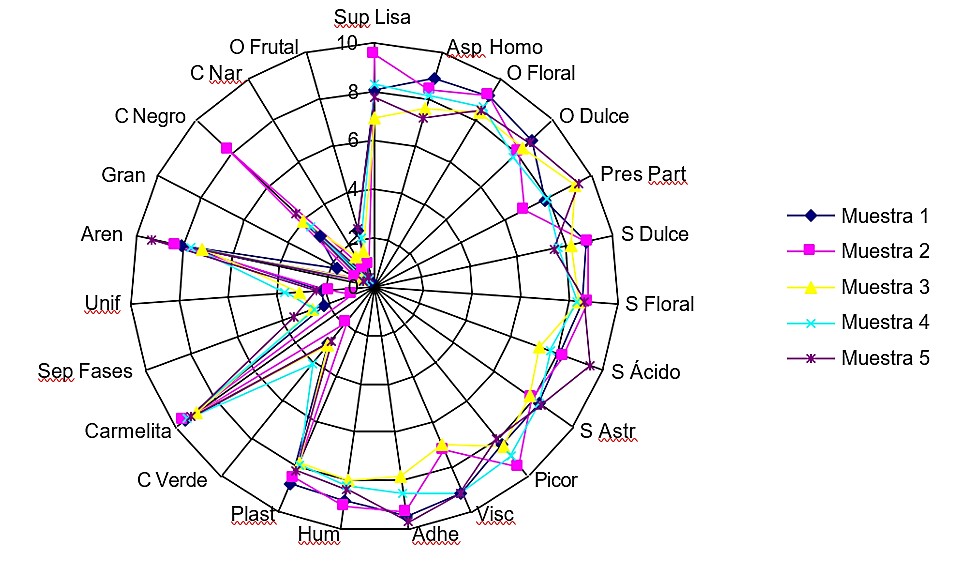
Silage bee pollen is a raw material of bee products for therapeutic and restorative purposes, for this reason demand the development of the sensory profile of the same, and their descriptive card, bringing the added value of the product is increased and contributes their comprehensive characterization. The present study aimed to carry out the preliminary selection of the descriptor terms of silage bee pollen sensory quality. Obtaining descriptor terms was conducted by the sensory panel and specialists Bee Research Center. 39 descriptor terms of silage bee pollen were obtained: 12 related to the appearance of the samples, 9 with the flavor, 10 with the texture and smell 8. A terms list reduction was made by NC-ISO 11035: 2008, wich suggests the use of certain methods such as intensity scale, geometric mean and statistics. The final descriptors were: smooth surface, uniform appearance, moisture, brown color, floral, sweet and sour scents, sweet, floral, sour, astringent and itching flavours and viscous, plastic, sandy and sticky textures. A preliminary descriptive record for silage bee pollen is proposed and concludes that best way of identifying attributes is one that involves several selection methods.
Article Details

This work is licensed under a Creative Commons Attribution-NonCommercial 4.0 International License.
Those authors who have publications with this journal accept the following terms of the License Attribution-NonCommercial 4.0 International (CC BY-NC 4.0):
You are free to:
- Share — copy and redistribute the material in any medium or format
- Adapt — remix, transform, and build upon the material
The licensor cannot revoke these freedoms as long as you follow the license terms.
Under the following terms:
- Attribution — You must give appropriate credit, provide a link to the license, and indicate if changes were made. You may do so in any reasonable manner, but not in any way that suggests the licensor endorses you or your use.
- NonCommercial — You may not use the material for commercial purposes.
- No additional restrictions — You may not apply legal terms or technological measures that legally restrict others from doing anything the license permits.
The journal is not responsible for the opinions and concepts expressed in the works, they are the sole responsibility of the authors. The Editor, with the assistance of the Editorial Committee, reserves the right to suggest or request advisable or necessary modifications. They are accepted to publish original scientific papers, research results of interest that have not been published or sent to another journal for the same purpose.
The mention of trademarks of equipment, instruments or specific materials is for identification purposes, and there is no promotional commitment in relation to them, neither by the authors nor by the publisher.
How to Cite
References
Baldi CB, Chaves PS, Fernández G. Caracterización Bromatológica del polen apícola argentino. Ciencia, Docencia y Tecnología. 2004; XV(029):145-181.
Barrios E. Capacidad antioxidante de extractos hidroalcohólicos de plantas aromáticas [disertación]. Tesis en opción al Titulo de Licenciado en Ciencias Alimentarias: Universidad de La Habana; 2009.
Erdtman O. Handbook of palinology. Hafner Publ Comp. New York; 1969.
Fonnegra GR. Métodos de estudio palinológicos. Centro de investigaciones Facultad de Ciencias Exactas y Naturales, Universidad de Antioquia. Medellín. 1989.
NC-ISO 11035: 2008. Análisis Sensorial-Identificación y selección de descriptores para el establecimiento de un perfil sensorial mediante un enfoque multidimensional.
Persano L, Piana L, Sabatini AG. Conocere il miele. Guida all Análisis Sensoriales. Instituto Nacionale di Apicultura. Bologna. Edizione Avenue Media; 1995.