Development and economical impact of organic honey production in Cuba
Article Sidebar
Main Article Content
Abstract
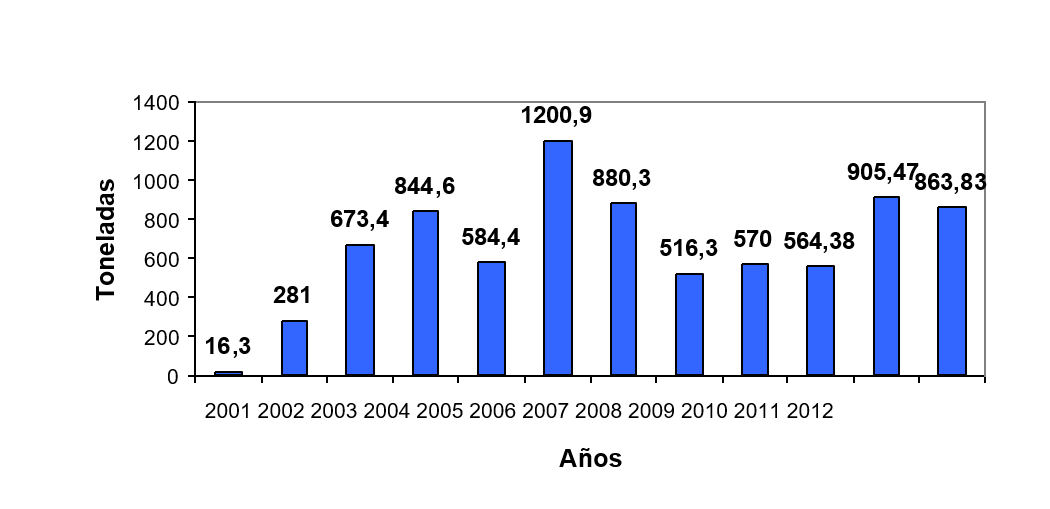
In order to perform a preliminary analysis of the relationship between the costs of certification for organic honey production and profits in the period between 2001 and 2012, we analyzed data on the cost of certification, production total honey, export price of honey and a comparison between the prices of conventional honey and organic honey. The organic production began to occur in 2001 in the province of Guantanamo with 16.3 t , becoming extended to other provinces reaching a production through 2012 of 7901.33 t. Likewise, it has increased the cost of certification, due to the greater number of beekeepers hired. These expenses attributed to certification, are offset by higher production levels and prices being quoted tempting with organic honey internationally, which has generated substantial gains to the country as well as the ability to bring to market products of the highest quality, able to meet the demands of an increasingly demanding and needy free food contaminant residues.
Article Details

This work is licensed under a Creative Commons Attribution-NonCommercial 4.0 International License.
Those authors who have publications with this journal accept the following terms of the License Attribution-NonCommercial 4.0 International (CC BY-NC 4.0):
You are free to:
- Share — copy and redistribute the material in any medium or format
- Adapt — remix, transform, and build upon the material
The licensor cannot revoke these freedoms as long as you follow the license terms.
Under the following terms:
- Attribution — You must give appropriate credit, provide a link to the license, and indicate if changes were made. You may do so in any reasonable manner, but not in any way that suggests the licensor endorses you or your use.
- NonCommercial — You may not use the material for commercial purposes.
- No additional restrictions — You may not apply legal terms or technological measures that legally restrict others from doing anything the license permits.
The journal is not responsible for the opinions and concepts expressed in the works, they are the sole responsibility of the authors. The Editor, with the assistance of the Editorial Committee, reserves the right to suggest or request advisable or necessary modifications. They are accepted to publish original scientific papers, research results of interest that have not been published or sent to another journal for the same purpose.
The mention of trademarks of equipment, instruments or specific materials is for identification purposes, and there is no promotional commitment in relation to them, neither by the authors nor by the publisher.
How to Cite
References
Acuña, G, J. Plantas melíferas de Cuba. Cuba. 1970. P 4-59.
Bahamonde, A; Alvero J, L; Instructivo de manejo Ecológico, Certificación y Comercialización de miles Ecológicas. BCS OKO GARANTIE. Centro de Investigaciones Apícolas. Cuba. 2000.
Caner, R, A. 2004. Clima de Cuba. Curso geografía de Cuba. Ed. Rebelde. La Habana, Cuba. 14.
Cuba. Agencia Certificadora BCS ÖKO GARANTIE. Registros de certificación y producción de miel ecológica cubana. 2011-2005.
Cuba. Centro de Investigaciones Apícolas. Ministerio de la Agricultura. Registro de Producciones Orgánicas. 2001-2011.
Cuba. Empresa CUBAEXPORT. Ministerio de Comercio Exterior. Registros de exportaciones de miel cubana. 2001-2011.
Cuba. Grupo Empresarial de Agricultura de Montaña; Empresa Apicola Cubana. Ministerio de la Agricultura. Boletín Informativo Estadístico. 2001-2011.
INSMET, 2001. Condiciones Climáticas Generales. Primera comunicación Nacional a la Convención Marco de las Naciones Unidas sobre Cambio Climático. Ed. CUBAENERGÍA, la Habana, Cuba.12.
Pérez, A, P; Manual de Apicultura. La Habana. Cuba. 2003.