Variation of HMF values and diastatic activity of honey in Cuba in the period 2001-2019
Article Sidebar
Main Article Content
Abstract
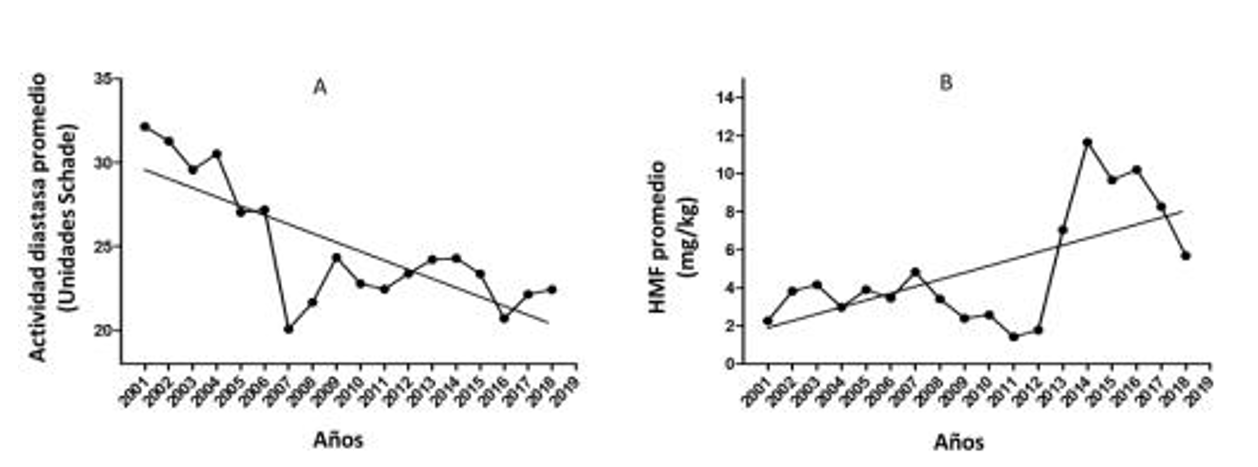
Concentration of HMF and activity of diastase as indicators of freshness are two of the main para-meters analyzed to assess the quality of honey. In this study, we analyze the historical variation of both parameters in Cuban commercial honey between 2001-2018. A decrease in diastase activity was recorded at an annual rate of 0.59 ± 0.26 Schade units while the concentration of HMF followed a tendency to increase. The results obtained in this study indicate a tendency to deteriorate the freshness of honey. Despite this, the analyzed honey continues to be considered as fresh and high-quality honey.
Article Details

This work is licensed under a Creative Commons Attribution-NonCommercial 4.0 International License.
Those authors who have publications with this journal accept the following terms of the License Attribution-NonCommercial 4.0 International (CC BY-NC 4.0):
You are free to:
- Share — copy and redistribute the material in any medium or format
- Adapt — remix, transform, and build upon the material
The licensor cannot revoke these freedoms as long as you follow the license terms.
Under the following terms:
- Attribution — You must give appropriate credit, provide a link to the license, and indicate if changes were made. You may do so in any reasonable manner, but not in any way that suggests the licensor endorses you or your use.
- NonCommercial — You may not use the material for commercial purposes.
- No additional restrictions — You may not apply legal terms or technological measures that legally restrict others from doing anything the license permits.
The journal is not responsible for the opinions and concepts expressed in the works, they are the sole responsibility of the authors. The Editor, with the assistance of the Editorial Committee, reserves the right to suggest or request advisable or necessary modifications. They are accepted to publish original scientific papers, research results of interest that have not been published or sent to another journal for the same purpose.
The mention of trademarks of equipment, instruments or specific materials is for identification purposes, and there is no promotional commitment in relation to them, neither by the authors nor by the publisher.
How to Cite
References
Arcos Farfán, L. J. (2016). "Análisis Físico Químico De La Miel De Abeja Clase II."
Bogdanov, S., C. Lüllmann, P. Martín, H. Russmann, G. Vorwohl and L. Persano Oddo (2000). "Calidad de la miel de abeja y están-dares de control: Revisión realizada por la Comisión Internacional de la Miel." Galeria Apícola Virtual.
Cervantes, M. R., S. G. Novelo and E. S. Duch (2000). "Effect of the temporary thermic treatment of honey on variation of the quality of the same during storage." Apiacta 35.
Cervera, S. S. and M. M. S. Cervera (1994). "Índice de diastasas y contenido en hidrosimetilfurfural en la mieles de La Rioja." Zubía.
Cheftel, J., J. Cuq and D. Lorient (1989). "Proteínas alimentarias.Editorial Acribia." Zaragoza, España. Cap 4.
Eshete, Y. and T. Eshetie (2019). "Review on the Effect of Processing Temperature and Time duration on Commercial Honey Quali-ty Parameters."
Europea, C. d. l. U. (2002). "Directiva 2001/110/ce del consejo de 20 de diciembre de 2001 relativa a la miel." Diario oficial de las Comunidades europeas, l10.
Fallico, B., M. Zappala, E. Arena and A. Verzera (2004). "Effects of conditioning on HMF content in unifloral honeys." Food Chemistry 85.
Gidamis, A. B., B. E. Chove, N. B. Shayo, S. A. Nnko and N. T. Bangu (2004). "Quality evaluation of honey harvested from selected areas in Tanzania with special emphasis on hydroxymethyl furfural (HMF) levels." Plant Foods for human nutrition 59.
Karabournioti, S. and P. Zervalaki (2001). "Efecto del calentamien-to en el HMF y la invertasa de la miel." Apiacta 36.
Lockhead, A. (1933). "Factors concerned with the fermentation of honey." Zentbl. Bakt. Parasitkde II Abst. 88.
Mouhoubi-Tafinine, Z., S. Ouchemoukh, H. Louaileche and A. Ta-mendjari (2018). "Effect of storage on hydroxymethylfurfural (HMF) and color of some Algerian honey." International Food Research Journal 25.
Pasias, I., I. Kiriakou, A. Kaitatzis, A. Koutelidakis and C. Proestos (2018). "Effect of late harvest and floral origin on honey antibac-terial properties and quality parameters." Food chemistry 242.
Singh, N., S. Singh, A. Bawa and K. Sekhon (1988). "Honey—its food uses." Indian Food Packer 42.
Solis-Silva, R., A. D. Hernández-Fuentes, R. Jimenez-Alvarado, G. Aguírre-Alvarez, J. A. Barrera-Jiménez and R. G. Campos-Montiel (2018). "Efecto del tratamiento térmico en la cristalización, activi-dad antioxidante e hidroximetilfurfural de una miel multifloral recién colectada." Investigación y Desarrollo en Ciencia y Tecno-logía de Alimentos 3.
Spano, N., L. Casula, A. Panzanelli, M. I. Pilo, P. C. Piu, R. Scanu, A. Tapparo and G. Sanna (2006). "An RP-HPLC determination of 5-hydroxymethylfurfural in honey: The case of strawberry tree honey." Talanta 68.
Subovsky, M. J., A. E. Castillo, A. Sosa López and N. Cano (2002). "Importancia de la calidad de la miel." Agrotecnia.(9): 25-27, 2002.
Subramanian, R., H. Umesh Hebbar and N. Rastogi (2007). "Processing of honey: a review." International Journal of Food Properties 10.
Tosi, E., Martinet, R., Ortega, M., Lucero, H., and Ré, R. (2008). "Honey diastase activity modified by heating." Food Chemistry 106.
Ulloa, J. A., Mondragon, P., Rodríguez, R., Resendiz, J. A., and Rosas, P. (2010). "La miel de abeja y su importancia." CONACYT.
Visquert Fas, M. (2016). Influencia de las condiciones térmicas en la calidad de la miel.
Wakhle, D. (1995). "Design for honey processing unit Part I." Ind. Bee J. 57.
White, J. W. (1994). "The role of HMF and diastase assays in honey quality evaluation." Bee world 75.