Preliminary sensory description of nature bee bread
Article Sidebar
Main Article Content
Abstract
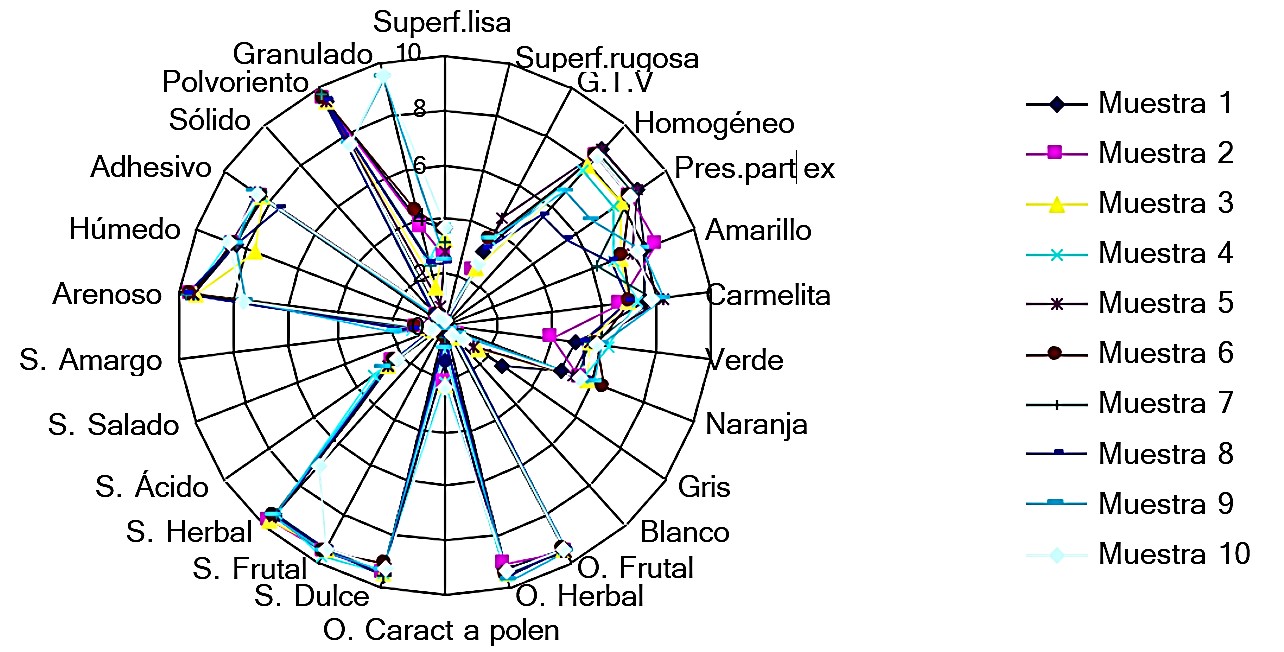
Sensory Analysis is an essential tool in assessing any food product. Provide regulatory documents related to the discipline and apply them properly is a guarantee on the quality of the sensory results. The country and specifically the Centre for Bee Research (CIAPI) haven’t regulatory documentation required related to sensory evaluation of natural bee bread, so the present study was aimed to describe the sensory attributes of natural bee bread through an partially trained commission. To this end, a descriptive terms selection was done using different methods such as using descriptive terms such as the reduction of irrelevant terms, followed by evaluation of the intensity of the attributes, calculating of the geometric mean and variance analysis. Of the 38 words generated, 15 were selected in three of the four methods: five related with appearance of the samples, four with the taste, four with the texture and two with the scent. From them, a descriptive record for natural bee bread was proposed, also concluded that the most complete form of attribute identification is one that involves several selection methods.
Article Details

This work is licensed under a Creative Commons Attribution-NonCommercial 4.0 International License.
Those authors who have publications with this journal accept the following terms of the License Attribution-NonCommercial 4.0 International (CC BY-NC 4.0):
You are free to:
- Share — copy and redistribute the material in any medium or format
- Adapt — remix, transform, and build upon the material
The licensor cannot revoke these freedoms as long as you follow the license terms.
Under the following terms:
- Attribution — You must give appropriate credit, provide a link to the license, and indicate if changes were made. You may do so in any reasonable manner, but not in any way that suggests the licensor endorses you or your use.
- NonCommercial — You may not use the material for commercial purposes.
- No additional restrictions — You may not apply legal terms or technological measures that legally restrict others from doing anything the license permits.
The journal is not responsible for the opinions and concepts expressed in the works, they are the sole responsibility of the authors. The Editor, with the assistance of the Editorial Committee, reserves the right to suggest or request advisable or necessary modifications. They are accepted to publish original scientific papers, research results of interest that have not been published or sent to another journal for the same purpose.
The mention of trademarks of equipment, instruments or specific materials is for identification purposes, and there is no promotional commitment in relation to them, neither by the authors nor by the publisher.
How to Cite
References
Del Risco, C. A; Rodríguez, Y; Rodríguez, G; Mosquera, D; Otero, H; Gómez, M; Morales, A. Caracterización del polen apícola: (3) Parámetros químicos después de ensilado en las celdas de las colmenas. Vida Apícola. 2010 160: 41-44.
Escobar, M. y Manresa, A. Caracterización y diferenciación del origen botánico de cuatro mieles uniflorales cubanas a partir del perfil sensorial. XVI Forum de Base de Ciencia y Técnica del Centro de Investigaciones Apícolas y XVI Fórum de Ciencia y Técnica del municipio Lisa. 2004.
Escobar, M. y Manresa, A. Análisis de componentes principales de mieles cubanas de diferente origen botánico: Mangle prieto (Avicennia germinans) y Leñatero (Gouania polygama). XV Forum de Base de Ciencia y Técnica del Centro de Investigaciones Apícolas y XV Forum de Ciencia y Técnica del municipio Lisa. 2003.
Estévez, Y.; Díaz, D. y Lorenzo, Y. Caracterización sensorial de mieles claras mediante análisis discriminante. Apiciencia. 2011 13(2).
Gilliam M. Microbiology of pollen and bee bread: The genus Bacillus. Apidology. 1979 10(3):269-274 (a).
Gilliam M. Microbiology of pollen and bee bread: The Yeast. Apidology. 1979 10(3):269-274 (b).
Hegazi AG. La apiterapia y sus componentes. El pan de abejas. Apiterapia [CD ROM]. XXXVII Congreso Internacional de Apimondia, celebrado en Durban, Sudáfrica; 2001.
Lorenzo, Y. y Manresa, A. Documentos técnico-normalizativos para el control de la calidad sensorial de la miel de abeja. Tesis en opción al grado de Master en Ciencias de los Alimentos. Universidad de La Habana, Instituto de Farmacia y Alimentos, Departamento de Alimentos; 2009. (N. del T.: En español: [tesis])
Lorenzo, Y.; García, Y; Manresa, A.; Estévez, Y. y Rodríguez, V. Evaluación sensorial de defectos en la miel de abeja. Apiciencia. 2010 12(2):20-26.
Manresa, A. Clasificación de mieles de abejas uniflorales mediante propiedades físico-químicas y sensoriales. Tesis en opción al grado de Doctor en Ciencias de los Alimentos. Universidad de La Habana, Instituto de Farmacia y Alimentos, Departamento de Alimentos; 2005. (N. del T.: En español: [tesis])
Manresa, A. Propiedades físico-químicas y sensoriales de mieles de abejas uniflorales cubanas. CENIC, Ciencias Biológicas. 2003 34(1) (a).
Manresa, A.; Lorenzo, Y.; Estévez, Y.; Castro, R. y Rodríguez, V. Empleo de Métodos Estadísticos para el procesamiento de datos en la diferenciación de mieles de abejas uniflorales [CD-ROM]. Memorias del III Congreso Cubano de Apicultura ISSBN 978-959-7139-86-7. Centro de Investigaciones Apícolas. La Habana, 9-13 marzo; 2009.
Manresa, Ada. Evaluación sensorial de miel de abejas específicas cubanas. Apiciencia. 2003 Julio (b).
NC- ISO 11035 (2008). Análisis sensorial. Identificación y selección de descriptores para el establecimiento de un perfil sensorial mediante un enfoque multidimensional.
NC-ISO 750: 2001. Producto de frutas y vegetales. Determinación de la acidez valorable.
NC-ISO1842: 52001. Productos de frutas y vegetales. Determinación del ph.
Pérez, Danae Santana; Yurenia Garcia Sarduy; Ada Manresa González; Yadiley Estévez Rodríguez y Vivian Rodríguez Ocampo. Adiestramiento de jueces analíticos en la evaluación de defectos de la miel de abeja [CD-ROM]. Memorias del III Congreso Cubano de Apicultura ISSBN 978-959-7139-86-7. Centro de Investigaciones Apícolas. La Habana, 9-13 marzo; 2009.
WIKILIBROS.ORG, (2010). Análisis sensorial de los alimentos/ texto completo.