Efectividad de las tiras de Bayvarol (Flumetrina) contra varroa utilizando como indicador el examen de abejas adultas
Article Sidebar
Main Article Content
Abstract
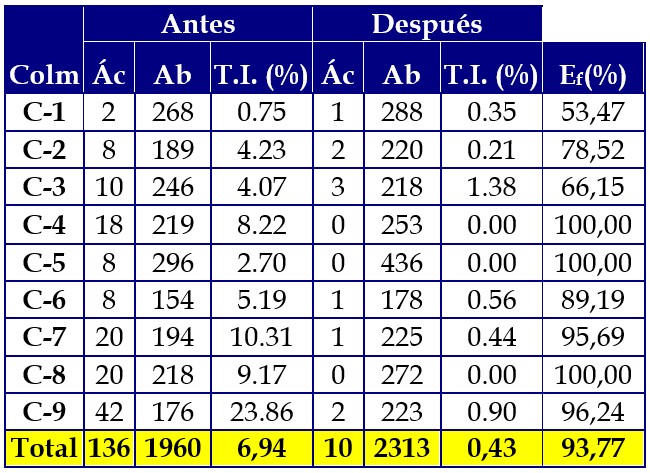
Varroasis had been affecting Apis mellifera bees in Cuba since 1996, promoting a decreasing in the number of beehives (Gonzáles, 1996). To control them many products had been use, some betters than others, and in this assay we had the objective to proved the effectiveness of Bayvarol Strips in production beehive taking the adults bee test as indicator of it. Nineteen production beehives were monitorized between February and March of 1997. All of them count with pour brood and pour laid. Bayvarol had been use as productor indications and the hives for its application were divided in two groups: one first group of 9 hives maintained the strips for 3 weeks and the second of 10 hives that maintained the strips for 4 weeks. The adults bees were obtained from the beehive interior and was calculated the Infestation rate of each. The results were compared by Wilcoxon test. As result we obtained that after 4 weeks of remained in hive the product achieved 100% effectiveness, differing significantly of the 3 weeks remaining group, in which the effectiveness reached a 93%. All hives got stronger and the queens started to laid eggs after Bayvarol application. It was concluded that Bayvarol is an effective chemist against this pathology in no brood rearing periods because made a considerable reduced in adults bees Infestation rates and that the permanence of Bayvarol less than 4 weeks does not guaranteed the maximum effectiveness of the product.
Article Details

This work is licensed under a Creative Commons Attribution-NonCommercial 4.0 International License.
Those authors who have publications with this journal accept the following terms of the License Attribution-NonCommercial 4.0 International (CC BY-NC 4.0):
You are free to:
- Share — copy and redistribute the material in any medium or format
- Adapt — remix, transform, and build upon the material
The licensor cannot revoke these freedoms as long as you follow the license terms.
Under the following terms:
- Attribution — You must give appropriate credit, provide a link to the license, and indicate if changes were made. You may do so in any reasonable manner, but not in any way that suggests the licensor endorses you or your use.
- NonCommercial — You may not use the material for commercial purposes.
- No additional restrictions — You may not apply legal terms or technological measures that legally restrict others from doing anything the license permits.
The journal is not responsible for the opinions and concepts expressed in the works, they are the sole responsibility of the authors. The Editor, with the assistance of the Editorial Committee, reserves the right to suggest or request advisable or necessary modifications. They are accepted to publish original scientific papers, research results of interest that have not been published or sent to another journal for the same purpose.
The mention of trademarks of equipment, instruments or specific materials is for identification purposes, and there is no promotional commitment in relation to them, neither by the authors nor by the publisher.
How to Cite
References
De Jong, D.; De Jong, P. and Gonçalves, L. Weight loss and other damage to developing worker honeybees from infestation with Varroa jacobsoni. Journal of Apicultural Research. 21: 165-167. (1982).
Eischen, F. Varroa resistance to fluvalinate. American Bee Journal. 135 (12): 815-816. (1995).
Faucon, J.P., Drajnudel, P. and Fleche, C. Varroasis: demonstrating resistance of the parasite to acaricides by means of the “determination of mean lethal time” method. Apidologie 27(2): 105-110. (1996).
Ferrer, M.; Moreno, C.; Martínez, A.I.; Sánchez, C.; Gracia, M.J. Field trials of treatments against Varroa jacobsoni using fluvalinate and flumethrin strips in honey bee colonies containing sealed brood. Journal of Apicultural Research. 1995, 34: 3, 147-152; Bb. (1995).
Frilli, F.; Milani, N.; Barbattini, R.; Greatti, M.; Chiesa, F.; Iob, M.; D' Agaro, M.; Prota, R. (ed.); Floris, I. The effectiveness of various acaricides in the control of Varroa jacobsoni and their tolerance by honeybees. Proceedings of 'The current state and development of research in apiculture', 25-26 October 1991, Aula Magna Facolta di Agraria, Sassari, Italy. 1992, 59-77; 19 ref. (1992).
González, G. Reporte preliminar del ácaro Varroa jacobsoni Oud. en tres apiarios de la provincia de Matanzas. Informe Técnico. Instituto de Medicina Veterinaria. Cuba. (1996).
Haupt,W.; Ribbeck, R.; Will, R.; Hertzsch, K. Experience in application of BAYVAROL STRIP R in various beehives controlling varroatosis under field conditions. Berliner und Munchener Tierarztliche Wochenschrift. 1996, 109: 6-7, 232 - 234, 236 - 238; 36 ref. (1996).
Kim, B.; Kawng, S.W.; Kim, B.G.; Kang, S.W. Studies on efficacy of Bayvarol against mite (Varroa jacobsoni) and safety of Bayvarol in honey bees. Korean Journal of Veterinary Clinical Medicine. 1995, 12: 1, 99-108; 5 ref. (1995).
Koeniger, N. y S. Fuchs. Bayvarol - Strips para diagnóstico y tratamiento de la varroasis. Separata del Deutsches Bienem Journal. Registro sanitario del Bayvarol en Alemania, (1995).
Milani, N. The resistance of Varroa jacobsoni Oud. to pyrethroids: a laboratory assay. Apidologie. 1995, 26: 5, 415-429; Bj. (1995).
Ruijter, A. de y Van den Eijnde, J. Ensayo de campo para determinar la eficacia de las tiras de Bayvarol contra los ácaros Varroa en colonias de abejas, así como la acción del preparado sobre el desarrollo de la colonia en los meses siguientes a la aplicación. Not. Med. Vet. 61: 30-35. (1991).
Robaux, P. Varroasis: ¿A partir de que umbral debemos tratarla?. Vida Apícola 23:42 - 44, (1987).
Schousboe, C. Varroasis y desarrollo larvario de las abejas. Vida Apícola 45: 36 - 45, (1991).
Wallner, K. The use of varroacides and their influence on the quality of bee products. Informe. Rucker de México S.A. (1996).