Uso del propóleos en el tratamiento de la sepsis vaginal
Article Sidebar
Main Article Content
Abstract
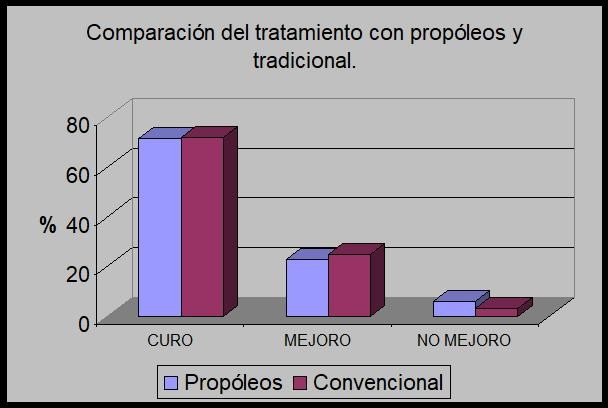
Se realizó un ensayo clínico controlado, explicativo, aplicado a 93 pacientes portadoras de sepsis vaginal. Se trataron 65 pacientes mediante curas vaginales con crema hidrófila de propóleos R al 5 % y 28 pacientes fueron tratadas con el tratamiento tradicional. Los casos fueron distribuidos en los dos tratamientos aleatoriamente. La verificación del diagnóstico y cura de las pacientes se realizó mediante estudio bacteriológico. Se evalúan los resultados alcanzados en el empleo de los diferentes tratamientos en relación a las curas realizadas y los exudados evolutivos, lo que demostró que no existen diferencias significativas en la evolución clínica de las pacientes al comparar los tratamientos.
Article Details

This work is licensed under a Creative Commons Attribution-NonCommercial 4.0 International License.
Those authors who have publications with this journal accept the following terms of the License Attribution-NonCommercial 4.0 International (CC BY-NC 4.0):
You are free to:
- Share — copy and redistribute the material in any medium or format
- Adapt — remix, transform, and build upon the material
The licensor cannot revoke these freedoms as long as you follow the license terms.
Under the following terms:
- Attribution — You must give appropriate credit, provide a link to the license, and indicate if changes were made. You may do so in any reasonable manner, but not in any way that suggests the licensor endorses you or your use.
- NonCommercial — You may not use the material for commercial purposes.
- No additional restrictions — You may not apply legal terms or technological measures that legally restrict others from doing anything the license permits.
The journal is not responsible for the opinions and concepts expressed in the works, they are the sole responsibility of the authors. The Editor, with the assistance of the Editorial Committee, reserves the right to suggest or request advisable or necessary modifications. They are accepted to publish original scientific papers, research results of interest that have not been published or sent to another journal for the same purpose.
The mention of trademarks of equipment, instruments or specific materials is for identification purposes, and there is no promotional commitment in relation to them, neither by the authors nor by the publisher.
How to Cite
References
Asís, M. “El propóleos, un valioso producto apícola”. C. Habana. Centro de Información y Documentación Agropecuaria (C.I.D.A.), 1979.
Cizmarik, J. , Trupl, J. “Acción del propóleos sobre las levaduras”XXV Congreso Internacional de Apicultura, Ed. APIMONDIA. Bucarest, 1975, pag. 94.
Bio Mericut E.T.S. “Clamydia”, plegable de 4 páginas, Impreso en Francia, 1989.
Pérez Piñeiro, A. Conferencia de apertura del 1er Simposio sobre el uso del propóleos en la Salud Humana y Animal. En Investigaciones Cubanas sobre le Propóleos. Matanzas, Consejo Científico del IMV, 1989.
Giral, T., Rodríguez, L., Raimont, R. Y ópez, M. “Ensayo Terapéutico del propóleos en las úlceras de los miembros inferiores”en Investigaciones Cubanas sobre el Propóleos, Matanzas, Consejo Científico del IMV, 1989.
Rojas, N. Y Lago, S. “Efecto antifúngico sobre cepas del género Candida”. En Investigaciones Cubanas sobre le Propóleos. Matanzas, Consejo Científico del IMV, 1989.
Jiménez, Z. Martínez, J. y Montes, J. “Aplicación del propóleos en la cervicitis inespecíficas”. C. de La Habana, Ed. Hospital Materno Infantil 10 de Octubre, 1998.
Jiménez, Z. Martínez, J. y Montes, J. “Aplicación del propóleos en heridas quirúrgicas”. C. de La Habana, Ed. Hospital Materno Infantil 10 de Octubre, 1998.
Castalleda Merayes, C. “Valor de un derivado a base de propóleos”. “La Propolisina en el tratamiento de la giardiasis del niño”. Cuba, Ed. Fac. de Biología, 1988.
Morales Vera, C. “Aplicación antimicrobiana de extractos de propóleos”. Trabajo de Diploma. C. Habana. Ed. Facultad de Biología, 1984.