Acciones del propóleo en la secreción ácido-gástrica
Article Sidebar
Main Article Content
Abstract
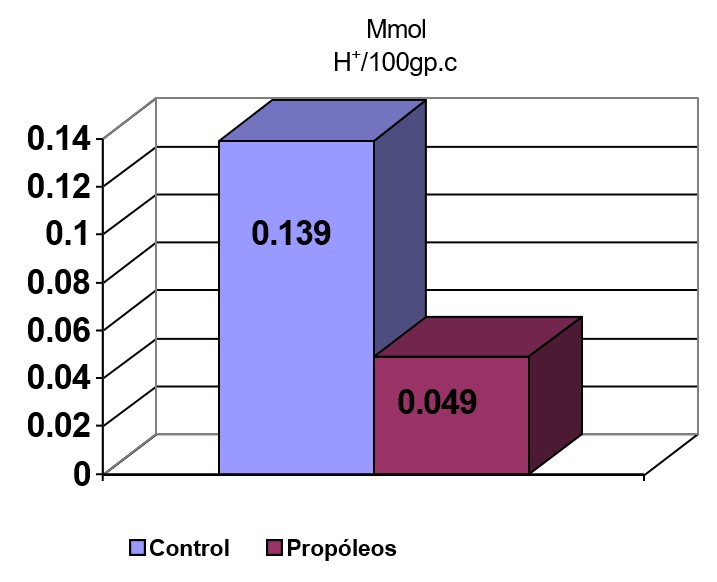
Existen diferentes informes sobre utilización del propóleos en las patologías gástricas asociadas con hiperacidez como son: la úlcera péptica y la gastritis. En estudios anteriores se ha demostrado el efecto protector de la mucosa gástrica y como continuidad de estos estudios se valoró el efecto del propóleos sobre la secreción ácido gástrica. Se utilizaron 32 ratas Sprague-Dawley (ambos sexos, 175-250 g) a las cuales se les realizó ligaduras del píloro durante cuatro horas. Se determinó el volumen total de jugo gástrico (m/100 g p.c.), pH y la salida de ácido (m/100 g p.c.). El Propóleos rojo (extracto alcohólica al 5 % se obtuvo en la Estación Experimental Apícola. Se administró en dosis de 50 mg/kg, por vía intraperitonial. Al grupo control se les administró etanol al 70 % isovolumétricamente por igual vía. Los resultados demostraron que el propóleos produce una disminución del volumen ácido-gástrico y una reducción significativa de la salida total de ácido, sin embargo, no modificó los valores del pH del contenido gástrico en ratas.
Article Details

This work is licensed under a Creative Commons Attribution-NonCommercial 4.0 International License.
Those authors who have publications with this journal accept the following terms of the License Attribution-NonCommercial 4.0 International (CC BY-NC 4.0):
You are free to:
- Share — copy and redistribute the material in any medium or format
- Adapt — remix, transform, and build upon the material
The licensor cannot revoke these freedoms as long as you follow the license terms.
Under the following terms:
- Attribution — You must give appropriate credit, provide a link to the license, and indicate if changes were made. You may do so in any reasonable manner, but not in any way that suggests the licensor endorses you or your use.
- NonCommercial — You may not use the material for commercial purposes.
- No additional restrictions — You may not apply legal terms or technological measures that legally restrict others from doing anything the license permits.
The journal is not responsible for the opinions and concepts expressed in the works, they are the sole responsibility of the authors. The Editor, with the assistance of the Editorial Committee, reserves the right to suggest or request advisable or necessary modifications. They are accepted to publish original scientific papers, research results of interest that have not been published or sent to another journal for the same purpose.
The mention of trademarks of equipment, instruments or specific materials is for identification purposes, and there is no promotional commitment in relation to them, neither by the authors nor by the publisher.
How to Cite
References
Aripov, K., J. Kamilov, and V.. Aliev Effect of propolis on experimental Stomach ulcers in rats. Medski Z
Moises, A. En: Propóleos: El oro púpura de las abejas La Habana: CIDA 1989.
Giral, T., Achong, M Ruíz y S. Fernández. Cienc. Téc. Agri. Apicultura 6: 61-69, 1990.
Kivalkina, V. Balance y perspectiva de la investigación del propóleos. En: Nuevas Investigaciones en la Apiterapia. Bucarest: Apimondia, 1976 --p. 204-208.
Lorenzo, J. A., S. Parrillo, G. Tamosiunas, A. M. Rodriguez y F. E. Estevez a/ Propóleos: Evaluación de efectos cardiovasculares y toxicológicos. Dpto de Farmacología y Terapeútica.— Montevideo: Facultad de Medicina, 1981.—8p.
Peschanskii, A. N. a/ Opit primenienua propolise priiazvemai helezni. Pchelovodstvo 11: 24, 1974.
Sosnowski, Z a/ Patent application methiod for extracting propolis and walter soluble day propolis powder obtained thereby and cosmetic and pharmaceutical preparations containing some. European Patent application 0109993, 1984. –sp.
Villalón, V., C. Nuñez, . J . Martínez y a. G. Chaumont a/ Tratamiento de la úlcera péptica gastroduenal con solución de propóleos. Informe preliminar. Segundo Simposio del propóleos y primero de Apiterapia y sus efectos en la salud humana y animal. – Matanzas: IMV Consejo Cientf. Veterinario, 1989 (Resúmenes).