Estudio preliminar del efecto radioprotector de diferentes propóleos cubanos
Article Sidebar
Main Article Content
Abstract
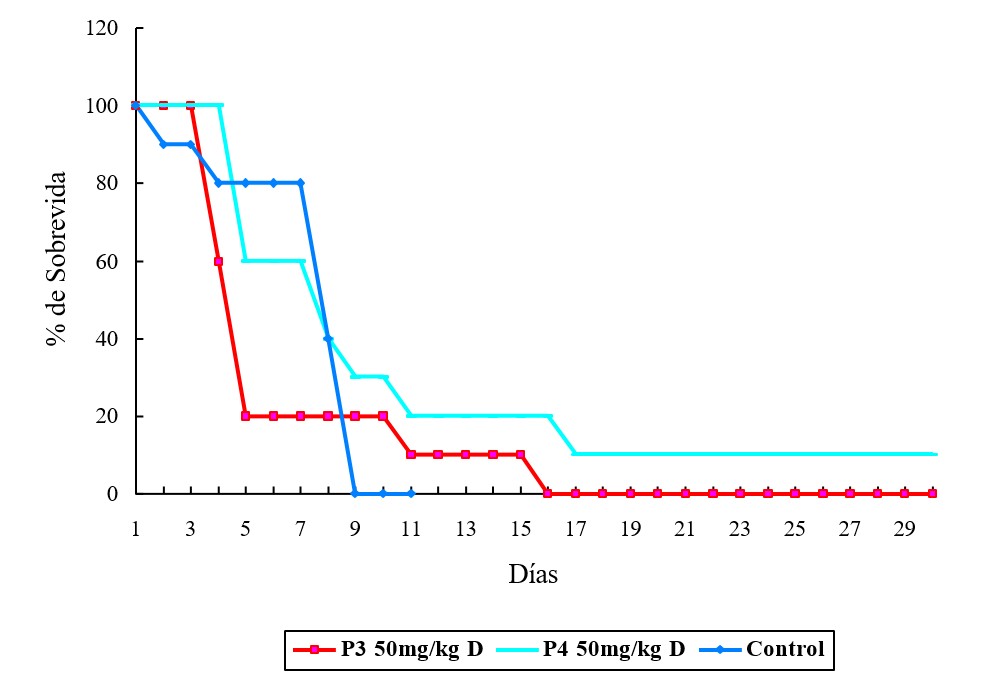
Las radiaciones a que se someten los enfermos de cáncer dejan en estos una serie de secuelas que suelen ser, en ocasiones, fatales. Dentro de los efectos adversos se encuentran: la depresión del sistema inmune, las lesiones epidérmicas, que pueden convertirse en daños más profundos con complicaciones sistémicas. Sabiendo, por referencias de otros investigadores, que los propóleos actúan como inmunoestimulantes, y partiendo de estudios realizados sobre el efecto radioprotector del propóleos, fueron objetivos de esta investigación estudiar si los mismos son capaces de proteger al sistema inmune del efecto de las radiaciones. Se ensayan los Extractos Etanólicos de Propóleos (EEP) de los propóleos P3 y P4 en ratones BDF1, los cuales fueron tratados con dosis de 50 mg/Kg antes de ser irradiados pancorporalmente con dosis mortales de 800 cGy de una fuente de cobalto 60; aumentando la sobrevida de los animales tratados respecto a los controles al cabo de los 30 días. Paralelamente a ello se someten ratones BDF1 a las radiaciones, e inmediatamente se tratan con dosis de 50 mg/Kg de los propóleos P3 y P4 intraperitonealmente (ip); no observándose diferencias significativas. Se hace evidente que estos propóleos muestran actividad radioprotectora, mientras que no tienen éxito en el tratamiento de la enfermedad radiante. Se ensayan los propóleos P3 y P4 disueltos en Tween, en dosis de 50 mg/Kg, antes o después de ser irradiados ratones BDF1 con dosis de 800 cGy sin que existan diferencias significativas entre los grupos.
Article Details

This work is licensed under a Creative Commons Attribution-NonCommercial 4.0 International License.
Those authors who have publications with this journal accept the following terms of the License Attribution-NonCommercial 4.0 International (CC BY-NC 4.0):
You are free to:
- Share — copy and redistribute the material in any medium or format
- Adapt — remix, transform, and build upon the material
The licensor cannot revoke these freedoms as long as you follow the license terms.
Under the following terms:
- Attribution — You must give appropriate credit, provide a link to the license, and indicate if changes were made. You may do so in any reasonable manner, but not in any way that suggests the licensor endorses you or your use.
- NonCommercial — You may not use the material for commercial purposes.
- No additional restrictions — You may not apply legal terms or technological measures that legally restrict others from doing anything the license permits.
The journal is not responsible for the opinions and concepts expressed in the works, they are the sole responsibility of the authors. The Editor, with the assistance of the Editorial Committee, reserves the right to suggest or request advisable or necessary modifications. They are accepted to publish original scientific papers, research results of interest that have not been published or sent to another journal for the same purpose.
The mention of trademarks of equipment, instruments or specific materials is for identification purposes, and there is no promotional commitment in relation to them, neither by the authors nor by the publisher.
How to Cite
References
Fernández, E. (1988). Biofarmacia. Tomo I. U. H. Fac. Farm. Alim. La Habana (Cuba).
Geran, R. I.; Greemberg, N. H.; Mc. Donald, M. M.; Schumacher, A. M. y Abbott, B. J. (1972). Protocols for screening chemical agents and natural products against animals tumors and other biological systems. Cancer Chemotherapy Reports, 3 (2).
Krol, W.; Czuba, Z. y Scheller, S. (1986). Immunology Pol., 11(40), 292.
Krol, W.; Czuba, Z.; Scheller, S.; Grabiec, J. y col. (1990). Antioxidant property of ethanolic extract of propolis (EEP) as evaluated by inhibiting the chemiluminiscence oxidation of luminol. Biochemistry International, 21(4), 593-597.
Matsuno, T. (1994). Antitumoral and Therapeutical effects of Propolis. Tokio (Japan).
Okonenko, L. B. (1986). EL propóleos como inhibidor de la oxidación de radicales libres de lípidos en la salmonelosis. Vaprosi. Predilsiskin, 45-46.
Pascual, C.; González, R. y Torricella, R. G. (1994). Scavenging action of propolis extract against oxygen radicals. J. E. Pharmacol., 41(1-2), 9-13.
Petrov, V. I. (1986). Inmunología Básica y Clínica. Ed. Pueblo y Educación. La Habana (Cuba).
Scheller, S.; Gazda, G.; Krol, W.; Czuba, Z. y col. (1989). Ethanolic Extract of Propolis (EEP) to protect mice against Gamma irradiation. Z. Naturforsch, 44c, 1049-1052.
Scheller, S.; Wilczok, T.; Imielsk, S.; Krol, W. y col. (1988). N. Med. Biol. (in press).