Haematoxylon campechianum L. flowering, precipitations and visit of honeybees in an area of the southwest of Dominican Republic
Article Sidebar
Main Article Content
Abstract
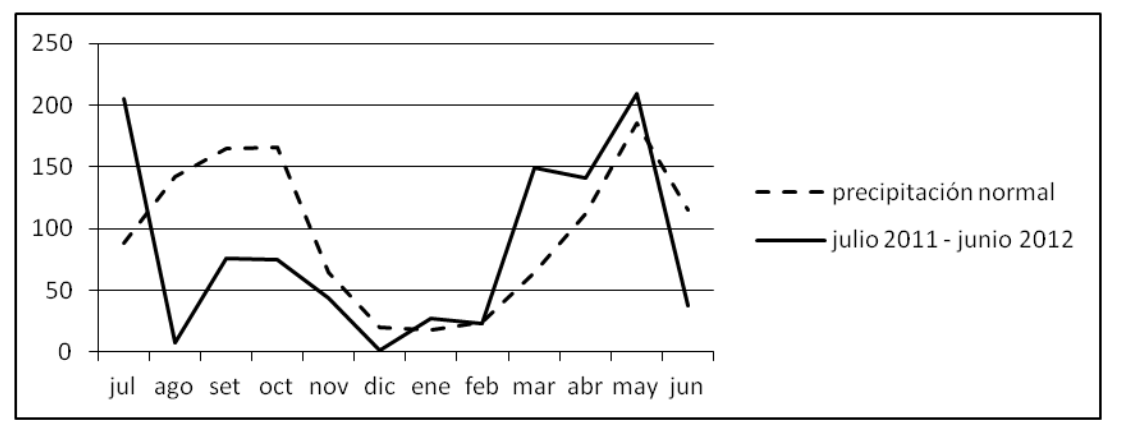
In the surroundings of Mata Yaya, in the south west of the Dominican Republic, observations were made of the flowering of Haematoxylon campechianum L., a species of interest to bee keeping, during the 2011 – 2012 season. The flowering period extends from November unto March/April, coinciding with the dry season. During this period, flowering happens as pulses, with high intensity and short duration, initiating four or five days after precipitation events and lasting about five to eight days. In order to make a better use of this flowering for honey production, it is recommended that other species are present, with flowering during the same period and more stable in time.
Article Details

This work is licensed under a Creative Commons Attribution-NonCommercial 4.0 International License.
Those authors who have publications with this journal accept the following terms of the License Attribution-NonCommercial 4.0 International (CC BY-NC 4.0):
You are free to:
- Share — copy and redistribute the material in any medium or format
- Adapt — remix, transform, and build upon the material
The licensor cannot revoke these freedoms as long as you follow the license terms.
Under the following terms:
- Attribution — You must give appropriate credit, provide a link to the license, and indicate if changes were made. You may do so in any reasonable manner, but not in any way that suggests the licensor endorses you or your use.
- NonCommercial — You may not use the material for commercial purposes.
- No additional restrictions — You may not apply legal terms or technological measures that legally restrict others from doing anything the license permits.
The journal is not responsible for the opinions and concepts expressed in the works, they are the sole responsibility of the authors. The Editor, with the assistance of the Editorial Committee, reserves the right to suggest or request advisable or necessary modifications. They are accepted to publish original scientific papers, research results of interest that have not been published or sent to another journal for the same purpose.
The mention of trademarks of equipment, instruments or specific materials is for identification purposes, and there is no promotional commitment in relation to them, neither by the authors nor by the publisher.
How to Cite
References
Borchert, R. 1994 a. Induction of rehydratation and bud break by irrigation or rain in deciduous trees of a tropical dry forest in Costa Rica. Trees 8: 198 - 204
Borchert, R. 1994 b. Soil and stem water storage determine phenology and distribution of tropical dry forest trees. Ecology 75: 1437 – 1449
Castillo-Amaro, E., Velázquez-Quintana, M., Rivero-Torreblanca, Y. & Sordo-Olivera, L. 2011. Arbolado para agricultura urbana y sub-urbana: Haematoxylon campechianum L. en reforestación de La Habana. Revista Forestal Baracoa, 30, número especial (sin paginación)
Fournier, L. A. & Charpentier, C. 1975. El tamaño de las muestras y frecuencia de observaciones en el estudio de las características de los árboles tropicales. Turrialba 25: 45 – 48
Geilfus, F. 1994. El árbol al servicio del agricultor. Manual de agroforestería para el desarrollo rural. Vol. 2: Guía de especies. Enda-Caribe/Catie, Turrialba/Costa Rica. 778 pp.
Holdridge, L. 1978. Ecología basada en zonas de vida IICA, San José, Costa Rica. 214 pp.
Lora Salcedo, R., J. Czerwenka & E. Bolay. 1983. Atlas de diagramas climáticos de República Dominicana. Santo Domingo, R. D., 91 pp.
Marcano, E. de J. 1974. Informe sobre la flora apícola dominicana. CEDOPEX, Santo Domingo. 62 pp. más anexos
Matteuci, S. D. & Colma, A. 1997. Agricultura sostenible y ecosistemas áridos y semiáridos en Venezuela. Interciencia 22 (3): 123 - 130
May, T. & Rodríguez, S. 2012 a. Percepción de apicultores sobre la importancia apícola de las plantas melíferas del bosque seco de la Línea Noroeste (República Dominicana). Revista de Investigación Agraria y Ambiental (Bogotá) 3 (1): 15 - 23
May, T. & Rodríguez, S. 2012 b. Plantas de interés apícola en el paisaje: Observaciones de campo y la percepción de apicultores en la República Dominicana. Revista Geográfica de América Central (Costa Rica) 48: 133 – 162
May, T., Rodríguez, S. & Rivas, S. 2008. Especies de plantas de importancia apícola en República Dominicana según la percepción de los apicultores. Moscosoa (Santo Domingo) 16: 148 – 168
Rodríguez Grullón, J. M. 1996. La era del Campeche. Distribuidora Rod, Santo Domingo.